
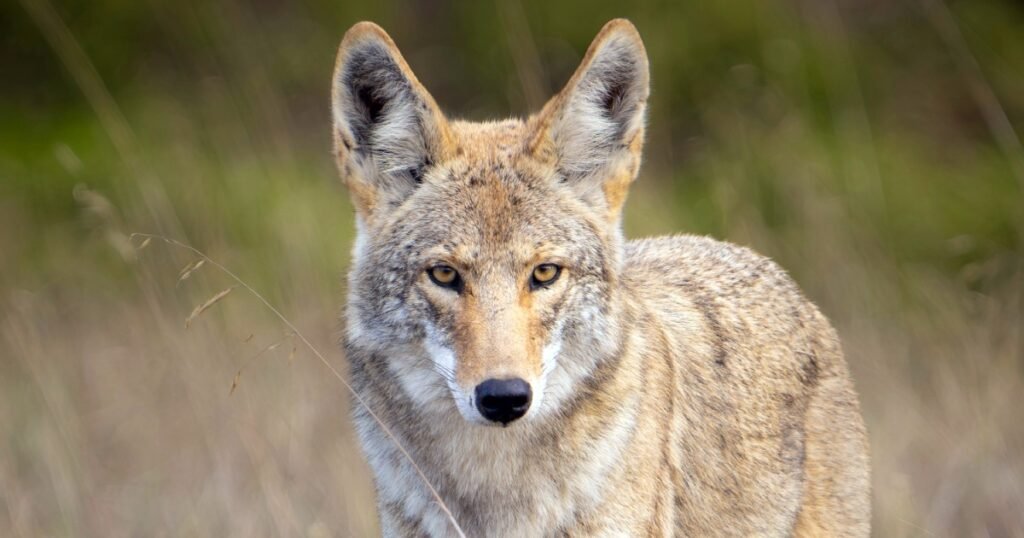
Source footage credits for every clip in this video are listed in full in the video description on YouTube.
If you have ever woken at 2am to what sounded like a dozen coyotes screaming somewhere behind the house, there is a good chance you were hearing two. Coyotes are unusually good at sounding like more coyotes than they are, and that is only one of several things their voices are doing that is easy to misread.
The standard reference for coyote vocal behaviour is still Philip Lehner’s 1978 study in Animal Behaviour, built from recordings of free-ranging and captive coyotes made between 1972 and 1975 and analysed on sound spectrograms. Lehner catalogued eleven distinct vocalizations and sorted them into three functional groups: agonistic calls used in conflict and submission, greeting calls used at close range, and contact calls used to reach animals far away.
Lehner was careful to add a caveat that most popular accounts drop: these sounds grade into one another, so splitting them into eleven types is partly a convenience. A whine can slide into a growl mid-breath. Keep that in mind as you listen — you are hearing points on a continuum, not eleven separate words.
Below are the seven coyote sounds you are most likely to actually hear, each with the audio from the video above. Click any button to jump straight to that sound.
All 7 Coyote Sounds At A Glance
| Sound | What it usually means | When you’ll hear it | Listen |
|---|---|---|---|
| Howl | Long-range contact: “here I am, this is our ground” | Dusk to dawn, year round, peaking in winter | |
| Yip | Part of the group chorus: family bonding plus territorial display | Evenings, when a family group reunites | |
| Scream | High arousal: startle, distress or a dispute at close quarters | Uncommon, and often misidentified | |
| Alarm call | “Something is wrong and it is close” — a warning to the family | Near dens, or when a person or dog gets too close | |
| Whine | Greeting or submission, depending on pitch | Within a family group, at close range | |
| Bark | Threat or alert aimed at something nearby | Defending a den, a carcass or a kill | |
| Growl | Close-range threat, usually face to face | Squabbles over food, or a cornered animal |
Contents:
1. The Coyote Howl
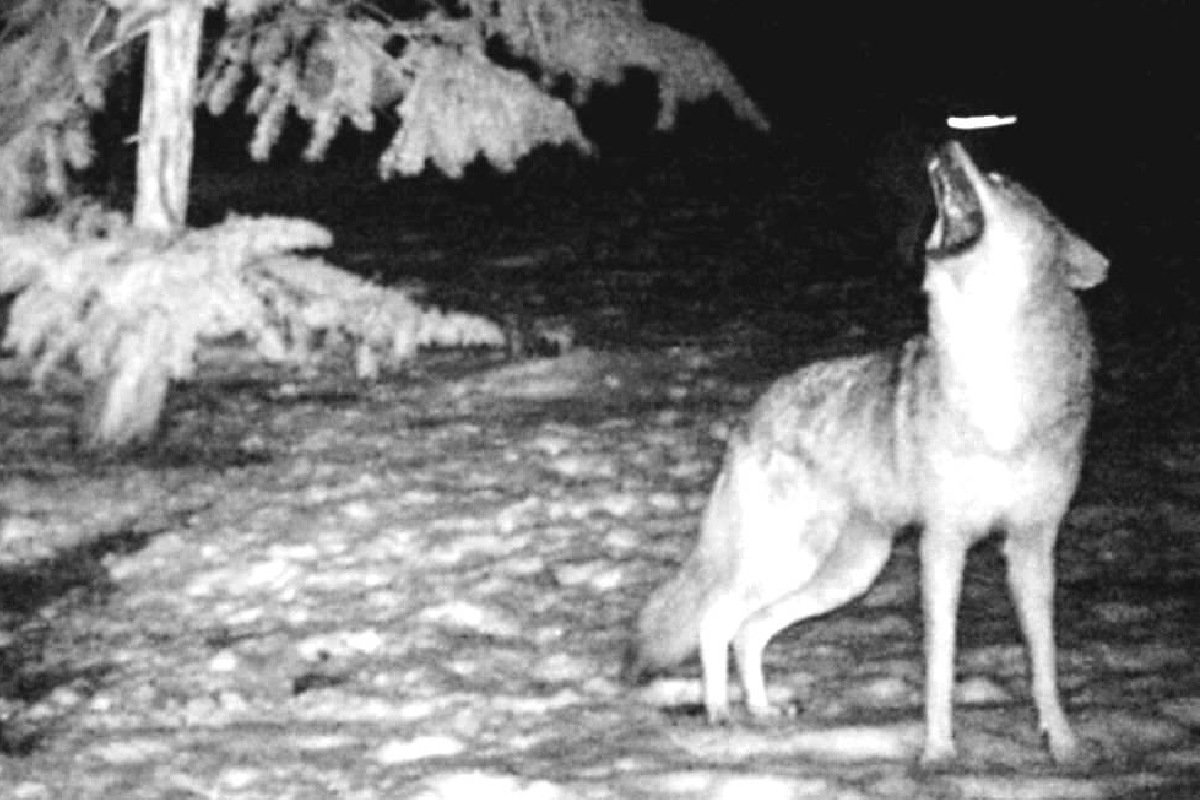
A howl is a long, rising, wavering note, often introduced by a short run of sharp barks. Lehner recorded two versions — the lone howl given by a single animal and the group howl given by several — and classified both as contact calls rather than aggressive ones. That distinction matters, because a howl is the sound most people instinctively read as menace.
Its real job is closer to a roll call. A coyote that has become separated from its family howls to announce where it is, and often gets an answer that lets the group reconverge. The same call doubles as an occupancy notice to neighbouring groups: this ground is taken.
Work by Mitchell and colleagues found that howls carry individually distinctive acoustic information that stays readable over distances of at least a kilometre. In other words, a howl is not a generic noise — it is closer to a name and an address, and it survives the trip.
The kill myth. A very common belief is that howling means a coyote pack has just brought something down. Wildlife agencies point out that this makes little sense: broadcasting your position over a fresh carcass would invite competitors to come and take it. Coyotes have every reason to eat quietly.
Also worth knowing:
- The short barks that often precede a lone howl were named “herald barks” by the ornithologist R. M. Mengel, and the label stuck.
- Because individual howls are acoustically distinctive, family members can plausibly tell each other apart by voice — the same property researchers exploit to identify individuals from recordings.
- Howling tends to increase through the winter breeding season, when pairs are most invested in advertising a territory.
2. The Coyote Yip
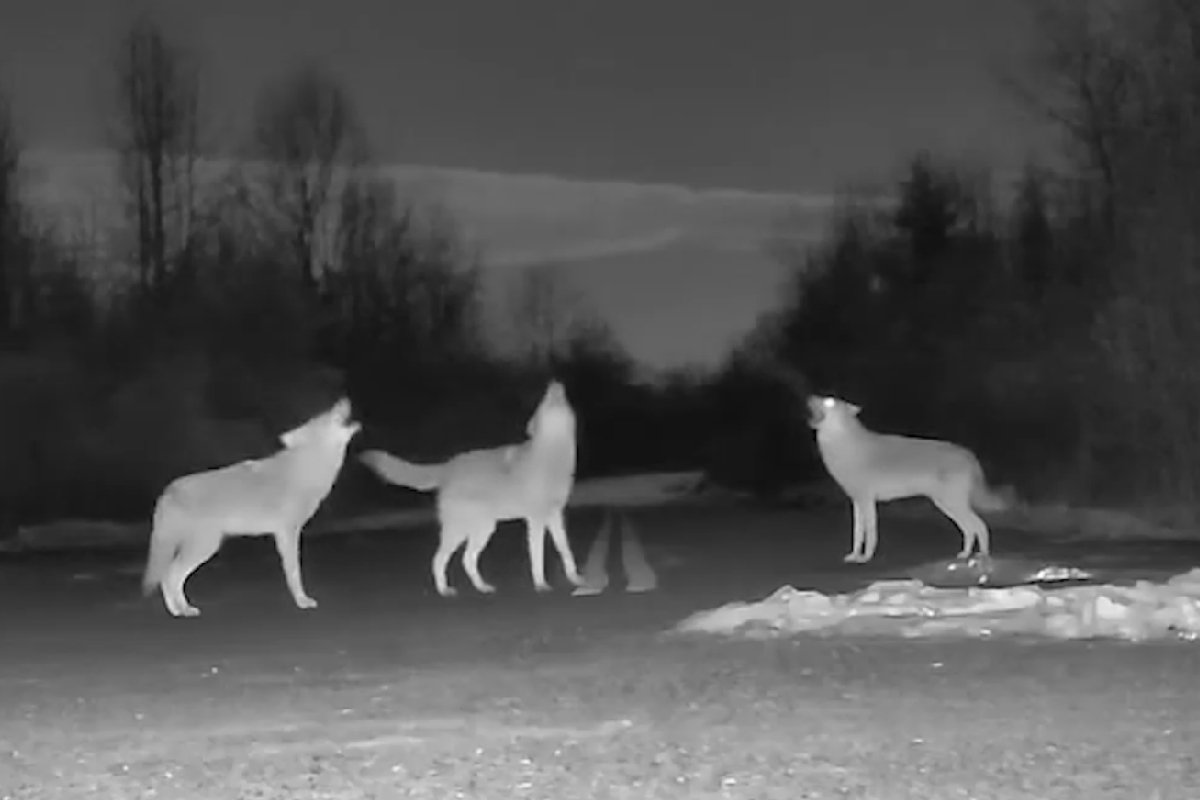
A yip on its own is a short, high, sharp cry. In practice you rarely hear one alone — yips are the staccato element inside the group yip-howl, the chaotic chorus that is the sound most people picture when they picture coyotes.
The chorus has a structure. Brian Mitchell describes it as being led by the territorial breeding pair, with the male carrying the howl while the female threads yips, barks and short howls through it. Offspring from previous years and that season’s pups join in if they are close by, or answer from elsewhere.
That layering is what produces the beau geste effect, an auditory illusion named after the novel in which a handful of soldiers prop up their fallen comrades so their position looks defended. Rapid shifts in pitch, overlapping voices and echo off the landscape make a very small group sound like a mob.
How badly do we misjudge it? Researchers at the Caesar Kleberg Wildlife Research Institute played listeners recordings containing between one and four coyotes and asked them to count. Estimates ran to roughly double the real number. If it sounds like eight, think four.
Functionally the chorus does two things at once. Inside the group it is social glue, performed on reunion in much the same spirit as a greeting ceremony. Outside it, it is a territorial advertisement — and one that deliberately overstates the numbers involved.
3. The Coyote Scream
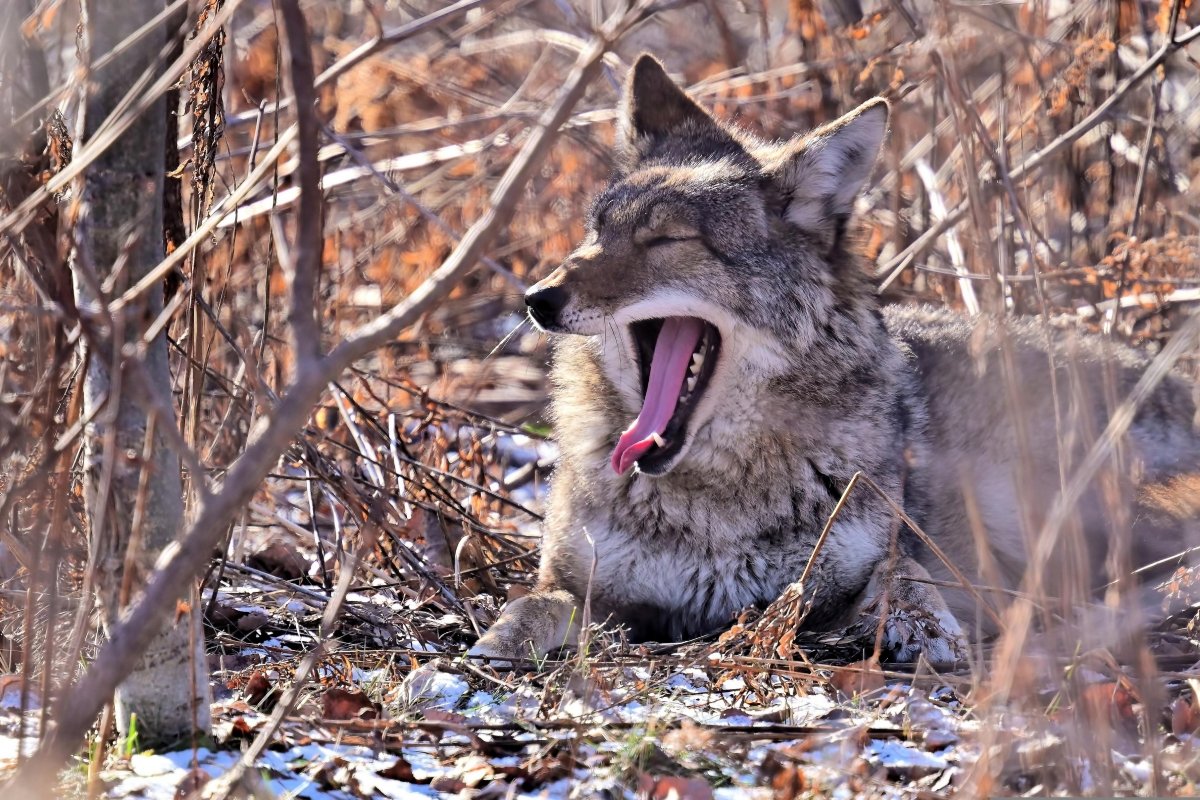
Worth being straight about this one: “scream” is what people call it, not what the literature calls it. There is no scream in Lehner’s eleven. The closest formal categories are the yelp, which he described as high-intensity submission or a startle response, and the high-frequency whine. What gets reported as a scream is usually one of those, pushed to the top of its range.
What it reliably tells you is that arousal is high. Something has startled the animal, a squabble has escalated, or a young coyote is in distress. What it does not reliably tell you is that anything violent is happening nearby — that inference is much shakier than the internet suggests.
Most likely explanation: it wasn’t a coyote. Of all the night sounds people report, the scream is the one most often pinned on the wrong animal. Red foxes and bobcats both produce screams that non-specialists routinely describe as a woman screaming, and both are far more likely culprits for a single isolated scream with no chorus around it. See the comparison below.
4. The Coyote Alarm Call
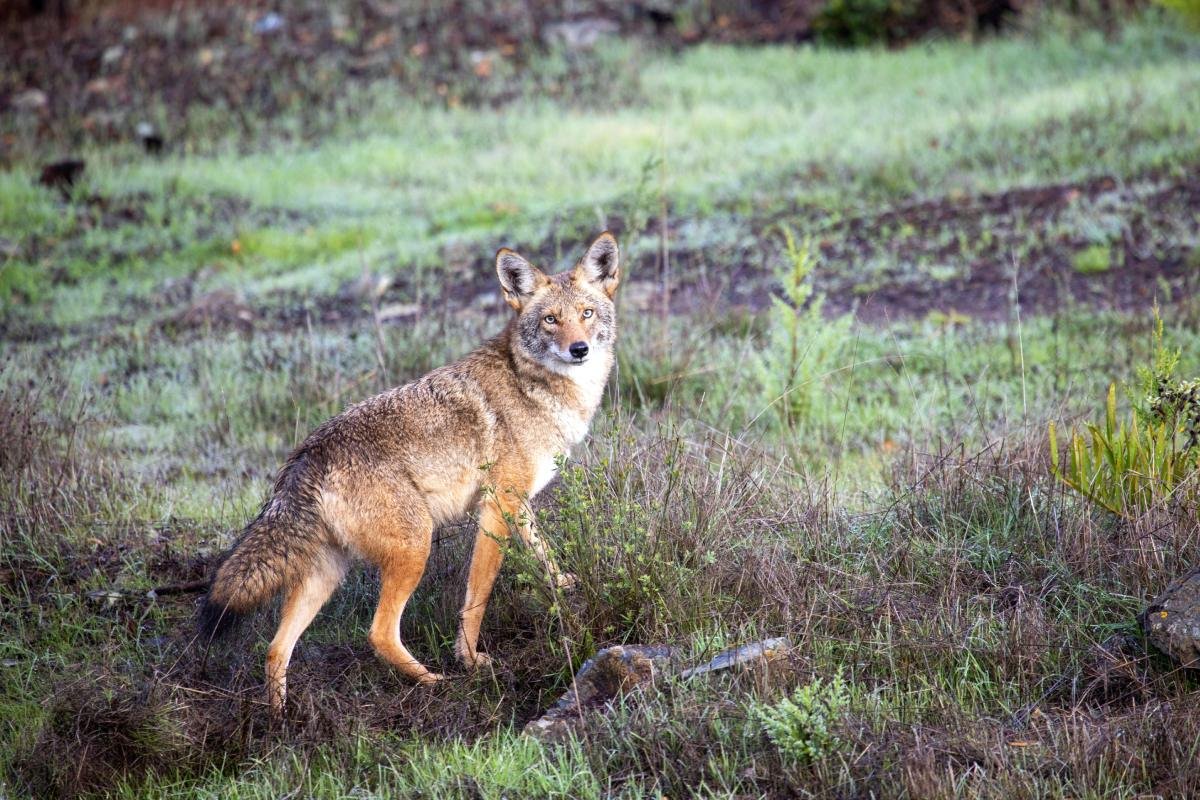
Coyote alarm sits on a scale. At the quiet end is the woof — a soft, low expulsion of breath given by an animal that has been startled and is not yet sure what it is looking at. It is a low-intensity warning meant only for whoever is standing nearby.
At the loud end is the bark-howl, which opens as a bark and blends into a howl. That one is a long-distance, high-intensity alarm: the coyote is now certain there is a problem, and is telling the whole neighbourhood about it.
You are most likely to trigger one in late spring and early summer, when pups are at or near a den. A coyote that barks at you repeatedly from a distance and refuses to leave is usually not stalking you; it is escorting you away from something it is guarding. Walking on in the direction you were already going normally ends the conversation.
Read it as distance, not danger. The useful signal in a coyote alarm is not how frightening it sounds but how sustained it is. A single woof means you surprised something. A prolonged bark-howl means you are near something it will not abandon.
5. The Coyote Whine
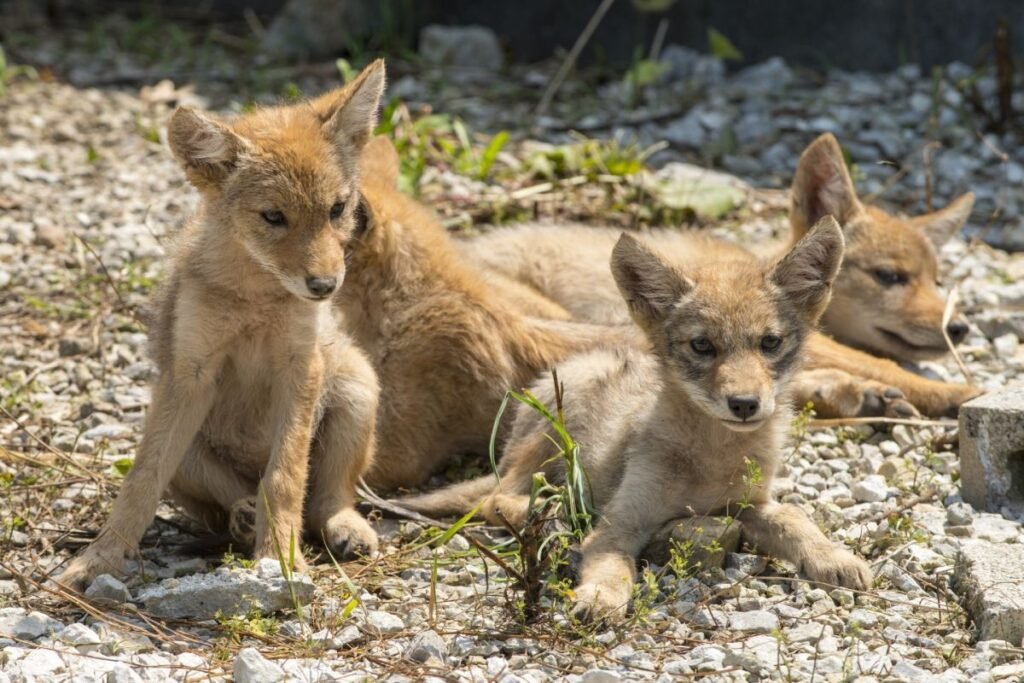
The whine is the clearest illustration of Lehner’s point about a graded continuum, because he had to list it twice. A low-frequency whine belongs to the greeting group: quiet, close-range, affiliative, the noise of animals pleased to see each other. A high-frequency whine belongs to the agonistic group: submission, usually offered by a subordinate to a dominant animal.
Same basic sound, two opposite social situations, separated mainly by pitch. Push it further up and it becomes a yelp. Let it drop and it slides toward a growl. This is why coyote communication resists neat translation — the categories are ours, and the animals are working with a dial rather than a set of switches.
Pups whine constantly — to solicit food, to get attention, and to appease adults. Because it is a short-range sound, hearing one at all usually means you are much closer to a den than you realised.
6. The Coyote Bark
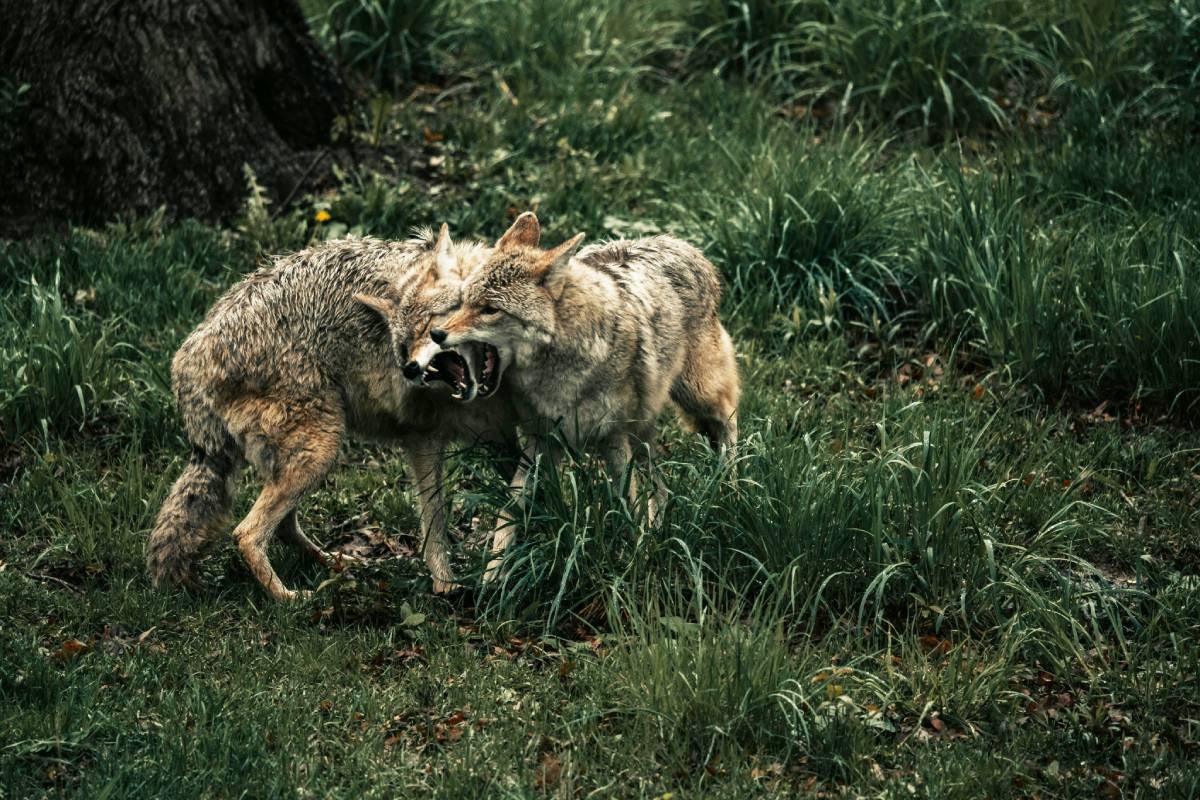
Lehner classed the bark as a threat or alert of low to medium intensity, aimed at something at moderate range — commonly a person, a dog, or a rival near a den or a carcass. It is more clipped and more variable than a domestic dog’s bark, and it rarely settles into the metronomic repetition a bored dog can keep up for an hour.
There is a neat acoustic reason the bark and the howl do different jobs. Mitchell and colleagues found that howls hold their information over long distances, while barks attenuate quickly and lose the detail that would identify the caller. A howl travels; a bark does not. So a bark is a statement about right here, and it is not really meant for anyone far away.
Practical consequence. If you can hear barking clearly, you are inside the range it was intended for. Howls can reach you from a kilometre away; barks generally cannot.
7. The Coyote Growl
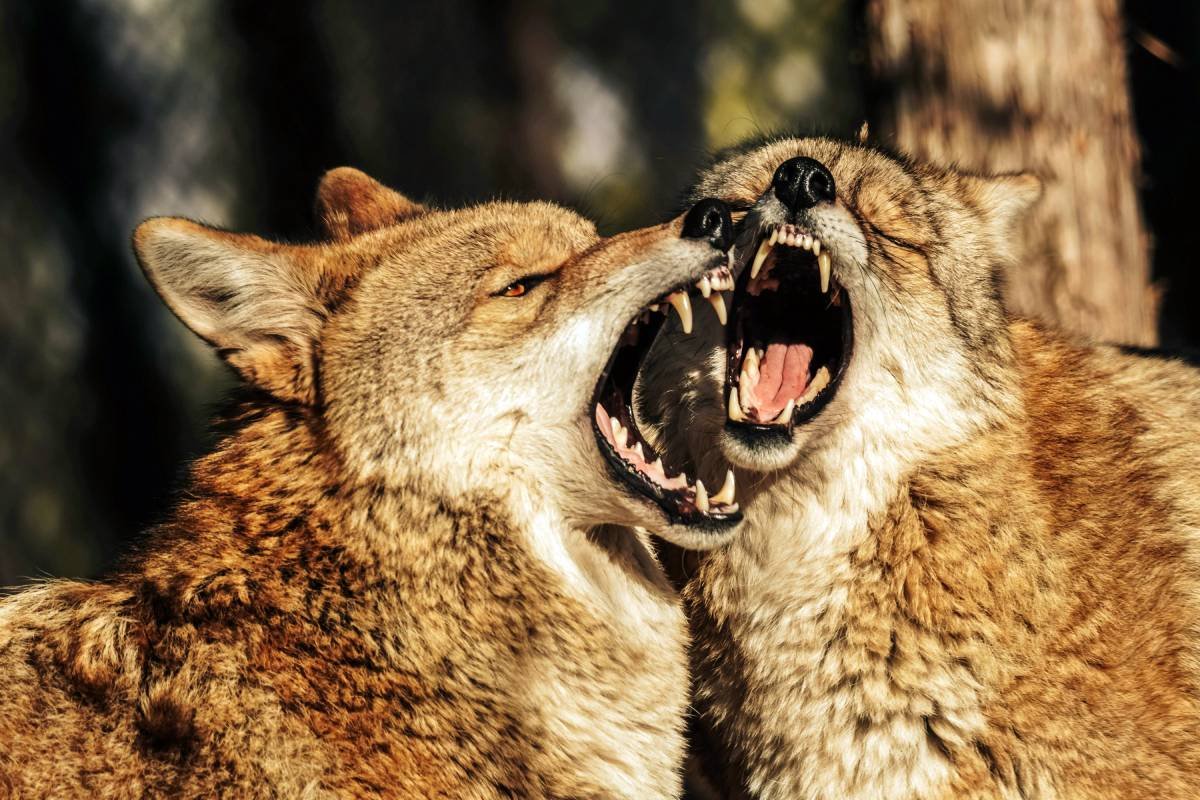
The growl is a close-range threat and the least ambiguous sound a coyote makes. It travels almost no distance, which tells you something in itself: it is meant for one recipient, standing right there, and it is a final notice before an interaction escalates.
Its usual companion is the huff, a sharp expulsion of air through the nose and mouth that Lehner recorded as a high-intensity close-quarters threat — commonly during squabbles over carrion, where two animals want the same thing and neither wants an actual fight.
Where the evidence runs out. Playback experiments with domestic dogs have shown that listeners can judge a growling animal’s body size from the sound alone, because larger vocal tracts produce lower resonances. It is a reasonable guess that coyote growls carry the same information, but as far as we can tell it has not been tested directly in coyotes. Treat it as a plausible inference, not an established fact.
Coyote, Fox, Dog or Wolf?
Most misidentifications come down to one of three mistakes. Here is what actually separates them.
| Animal | What gives it away |
|---|---|
| Coyote | Higher pitched and more chaotic than you expect. Chorus mixes howls, yips and barks at once, and changes rapidly. A group event, not a solo performance. |
| Wolf | Lower, deeper, far more sustained — long notes held on a single breath. No yipping, and the overall effect is mournful rather than frantic. |
| Red fox | A hoarse, short, repeated scream with pauses between. No chorus. This is the classic “woman screaming in the woods” sound and the most common false positive for a coyote scream. |
| Domestic dog | Regular and repetitive. A dog will bark at the same pitch and interval for long stretches; coyotes rarely stay that consistent. |
The single most useful test: was there a chorus? Coyotes are strongly inclined to answer each other, so a coyote event usually involves several voices overlapping and shifting. One isolated scream with silence on either side is much more likely a fox or a bobcat.
When Are Coyotes Loudest?
Vocal activity concentrates around dusk and through the night, and it is not evenly spread across the year. Winter brings the breeding season, when pairs have the strongest reason to advertise a territory. Late spring and early summer shift the balance toward alarm calls as pups occupy dens. Autumn brings dispersal, when young animals leave and howl to locate each other and to test unfamiliar ground.
The siren response is real enough that researchers rely on it: broadcasting sirens or recorded howls to provoke an answer is a standard survey technique for estimating where coyotes are. Whether the animals are answering the siren as though it were a howl, or simply reacting to a sudden loud noise, is not fully settled.
Frequently Asked Questions
Does coyote howling mean they have made a kill?
Almost certainly not. Howling is a contact and territorial call, and announcing your location while standing over food would attract competitors rather than deter them. Coyotes howl for many reasons; a fresh kill is not one of the well-supported ones.
How many coyotes am I actually hearing?
Fewer than it sounds like. In playback tests, listeners given recordings of one to four coyotes overestimated the number by roughly two-fold. Two animals can convincingly sound like seven or eight. Halving your instinctive estimate is a reasonable correction.
Why do coyotes howl at sirens?
A siren shares acoustic features with a howl — a sustained, frequency-modulated tone — and coyotes are strongly inclined to answer howls. Researchers use sirens deliberately to elicit responses during surveys. Whether the animals genuinely mistake it for another coyote or are simply responding to a loud sustained sound is not settled.
Is a coyote screaming near my house a sign of danger?
A scream indicates high arousal — a startle, a dispute, or distress — but it is not evidence of a threat to you, and a single isolated scream is more likely to be a red fox or a bobcat than a coyote at all. Persistent barking is the call actually aimed at people, and it generally means you are close to a den or a food source.
How do I tell a coyote from a fox at night?
Listen for a chorus. Coyotes answer each other, so their calls usually involve several overlapping voices mixing howls, yips and barks. A red fox scream is hoarse, short, repeated at intervals and solitary.
What time of year are coyotes loudest?
Activity peaks around the winter breeding season, with a second rise in autumn when young animals disperse. Late spring and early summer bring more alarm calls as pups occupy dens. Across the whole year, most vocal activity happens between dusk and dawn.
Sources
- Lehner, P. N. (1978). Coyote vocalizations: a lexicon and comparisons with other canids. Animal Behaviour, 26(3), 712–722.
- Lehner, P. N. (1978). Coyote communication. In M. Bekoff (Ed.), Coyotes: Biology, Behavior, and Management (pp. 127–162). Academic Press.
- Lehner, P. N. (1982). Differential vocal response of coyotes to “group howl” and “group yip-howl” playbacks.
- McCarley, H. (1975). Long-distance vocalizations of coyotes (Canis latrans). Journal of Mammalogy, 56, 847–856.
- Mitchell, B. R., Makagon, M. M., Jaeger, M. M., & Barrett, R. H. (2006). Information content of coyote barks and howls. Bioacoustics, 15, 289–314.
- Petroelje, T. R., Belant, J. L., & Beyer, D. E. (2013). Factors affecting the elicitation of vocal responses from coyotes. Wildlife Biology, 19(1).
- Caesar Kleberg Wildlife Research Institute playback study on listener estimates of coyote group size, summarised by WildlifeHelp.org.
- Mitchell, B. R. Coyotes: listening to tricksters. Northern Woodlands (Outside Story).
Where a claim rests on inference rather than direct evidence from coyotes, it is flagged as such in the text. The body-size point in the growl section is the main example.